Glass Jewelry Display Cases: Materials, Security, and Lighting
A practical B2B guide to buying glass jewelry display cases, covering glass types, stainless steel finishes, security, lighting, freight, and quotation evaluation.
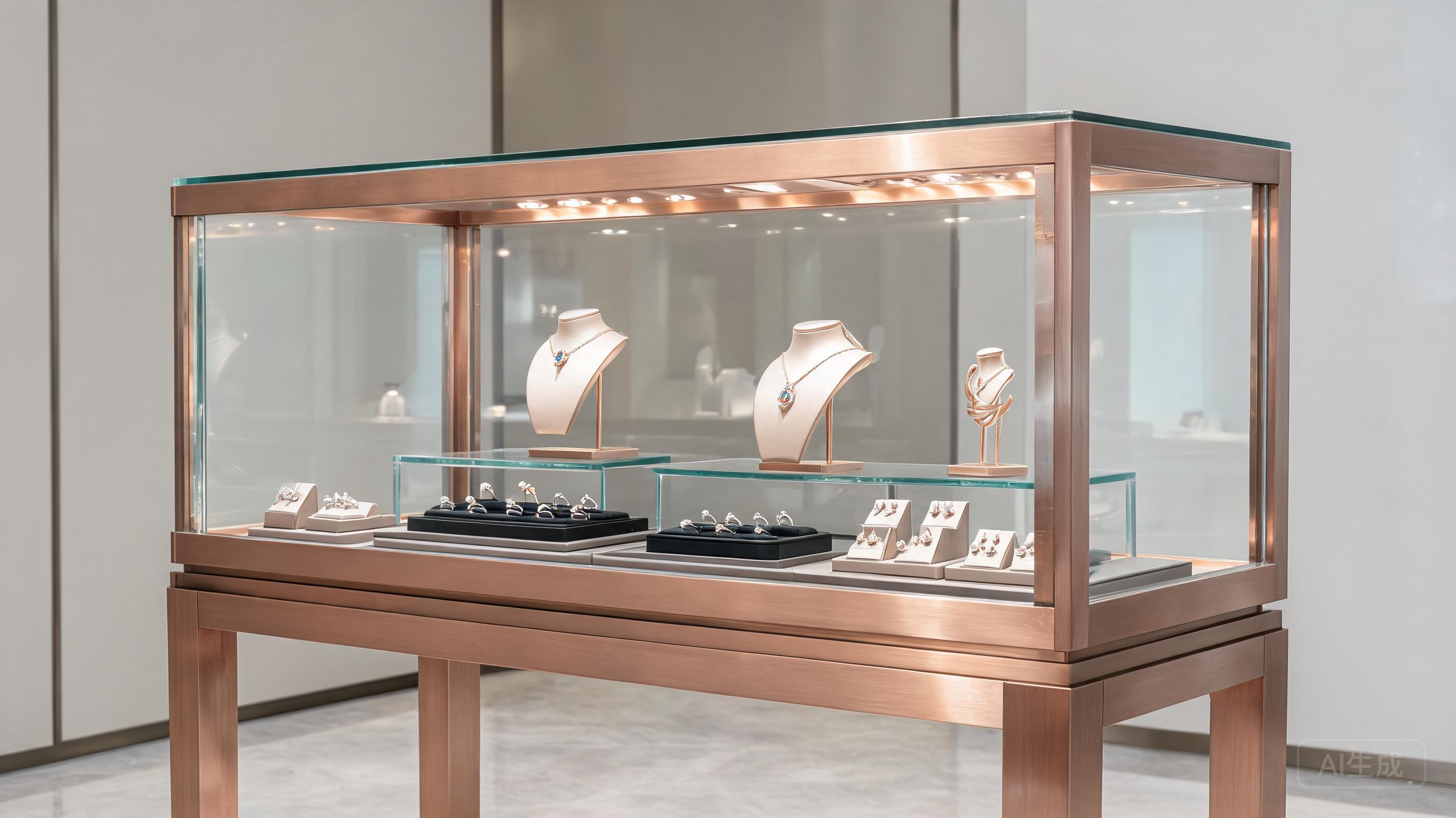
Zhengzhou Cangbaoge Showcase Factory is a custom jewelry display case manufacturer based in Zhengzhou, China. Glass jewelry display cases are the backbone of any jewelry retail environment because they combine product visibility, physical security, and controlled lighting into a single fixture — and the right choice depends on matching glass type, frame material, locking systems, and light specifications to your specific store layout and product mix.
Key Takeaways
- Best choice: A custom glass jewelry display case with low-iron tempered glass, a stainless steel vacuum-plated frame, and LED lighting at 3000K to 4000K color temperature.
- Suitable for: Jewelry retailers, gold stores, watch shops, mall kiosks, brand flagship stores, and multi-location chains that can plan lead time and coordinate freight.
- Main decision factors: Glass type, frame material and finish, locking and drawer configuration, lighting color rendering, and shop drawing approval.
- Primary risks: Undefined electrical requirements, unverified dimensions, unclear import responsibilities, and lack of a local receiving and installation plan.
- Recommended next step: Prepare your floor plan, field dimensions, reference images, product categories, and delivery ZIP code before requesting project-based quotations.
1. What Type of Glass Jewelry Display Case Should You Buy?
For most jewelry retailers, the strongest choice is a tempered glass display case with a stainless steel frame and a vacuum-plated finish. Tempered glass resists impact better than standard annealed glass, and low-iron tempered glass eliminates the green tint that distorts the color of gold, diamonds, and colored gemstones. If your case will sit at a counter where customers lean or reach, tempered glass is the appropriate baseline.
Frameless glass cases provide a wider, uninterrupted view of the merchandise, which works well for high-end or statement pieces. Hot-bent curved glass cases create a more distinctive silhouette for flagship stores but cost more and require more precise fabrication. For standard mall counter placements, a straight, low-profile glass case with a stainless steel base is the most practical starting point because it is easier to replicate across locations and simpler to install in tight spaces.
You also need to decide between wall cabinets, tall cabinets, low cabinets, and island counters. Wall cabinets maximize back-wall display density. Tall cabinets suit watches and higher-end items that benefit from vertical sightlines. Low cabinets and island counters place products closer to the customer and work well for engagement rings, pendants, and earrings. Round glass dome cases and oval display cases are useful for focal pieces or window displays, but they are not efficient for high-density merchandise.
2. Cabinet Dimensions and Store Layout Planning
Before contacting any jewelry showcase factory, measure the actual installation area in inches and millimeters. Wall-mounted cases typically range from 36 to 48 inches (914 to 1219 mm) in height, while low island counters sit around 36 to 40 inches (914 to 1016 mm) so customers can view merchandise comfortably. Tall cabinets commonly reach 72 to 84 inches (1829 to 2134 mm).
You need to confirm not just the footprint of each case, but also the aisle width, the swing path of doors, the location of electrical outlets, and the clearance needed for delivery. Mall tenant criteria often restrict the height, depth, and electrical load of display fixtures, so check those requirements before you finalize dimensions. If you are working with a general contractor or retail designer, they should issue a reflected ceiling plan and a furniture layout that your case supplier can use to produce shop drawings.
Your floor plan must also account for the crate size of each delivered case. A low counter may ship in a crate of roughly 60 x 36 x 40 inches (1524 x 914 x 1016 mm), but larger tall cabinets or curved cases produce larger crates. Confirm that the crating can pass through your storefront, elevator, and interior doorways. If you are receiving on a loading dock or through a standard double door, the receiving team needs to know the crate dimensions in advance.
3. Materials, Glass, and Finish Comparison
The table below compares the main material and glass options buyers encounter when evaluating glass jewelry display cases.
| Case Component | Common Options | Best For | Main Limitations | Buyer Questions |
|---|---|---|---|---|
| Frame material | Stainless steel, wood, MDF with laminate | Stainless steel suits high-traffic stores and modern design; wood suits traditional interiors | Wood can warp or scratch; MDF needs protective edging | Will the frame resist daily cleaning and customer contact? |
| Frame finish | Vacuum-plated stainless steel in colors like titanium gold, black titanium, champagne gold | Matching brand colors and premium presentation | Vacuum plating requires skilled fabrication to avoid uneven color | Are color samples or finish swatches available? |
| Glass type | Standard tempered, low-iron tempered, laminated | Low-iron tempered for true color; laminated for high-security | Laminated glass costs more and increases weight | Is the glass tempered? Is it low-iron? What thickness is specified? |
| Glass style | Flat, curved, hot-bent, frameless | Frameless and curved for premium displays; flat for cost control and quick installation | Curved glass increases fabrication time and cost | What is the delivery impact of curved glass? |
| Base material | Stainless steel, wood, stone laminate | Stainless steel for durability and clean lines | Wood bases require careful sealing and finishing | Is the base structural or decorative? |
| Locking and access | Sliding doors, hinged doors, lift-up glass, locking drawers | Lift-up glass for counter access; hinged doors for wall cabinets | Sliding doors need clean tracks; lift-up mechanisms require maintenance | Are locks keyed alike? Can you reorder keys? |
Stainless steel frames finished with vacuum plating deliver a consistent metallic look that resists fingerprints and scratches better than painted surfaces. The vacuum-plating process binds the color to the steel rather than applying a surface coat that can chip. If you are building a chain of stores, a vacuum-plated stainless steel finish gives you a repeatable standard color across batch production.
4. Security: Locks, Drawers, and Access Control
Security is not an afterthought for glass jewelry display cases — it is a core specification. Confirm that every glass panel is tempered or laminated and that all access points are lockable. For wall cabinets, use locking hinged doors with a flush or recessed lock. For low counters, decide whether you want lift-up glass panels with gas struts or sliding doors. If the case holds high-value merchandise, consider locking drawers that are accessible only from the staff side.
Ask whether the locks are keyed alike across all cases in the store, whether replacement keys are available, and whether the locking mechanism is compatible with your store's master key system. It is not safe to assume that an overseas manufacturer supplies US-compliant locking hardware, so verify the lock cylinder type and whether it meets mall or insurance requirements.
If the case is installed in a mall, check the tenant criteria for security glazing. Some mall landlords require laminated glass or specific lock types for stores above a certain value threshold. A custom jewelry display case manufacturer can build to your specifications, but you must confirm the security standard with your landlord or security consultant before production.
5. Lighting Color Temperature and Color Rendering
Lighting makes or breaks the perceived value of jewelry. LED strips are the current standard because they produce minimal heat, last longer than fluorescent tubes, and allow precise color control. For jewelry displays, choose LEDs with a color temperature between 3000K and 4000K. Warmer light (3000K) flatters gold and rose gold, while slightly cooler light (4000K) enhances white metals, diamonds, and platinum.
More important than color temperature is color rendering index (CRI). Use lighting with a CRI of 90 or above so gemstone color and metal tone appear accurate. If you sell diamonds, ask about the specific spectral output of the LED strip; some LEDs with high CRI still produce a slight yellow or green cast that dulls diamond brilliance.
The lighting driver must match the destination electrical system. For US projects, confirm that the fixture is wired for 110–120V. Also ask whether the driver is replaceable, where it is located, and whether the lighting can be dimmed. Independent retail designers and contractors should note that lighting components are often subject to local electrical inspection, so verify the complete electrical installation with the local authority having jurisdiction.
6. Welding, Polishing, and Visible Joint Quality
The difference between an inexpensive display case and a premium one is often in the details of welding, polishing, and seams. Look at the case body from three views: front, side, and interior. Covers and panels should meet evenly, without visible gaps, misalignment, or rough edges. Stainless steel frames should have clean, continuous welds that are ground flat and polished so the joint disappears into the surrounding surface.
A curved-glass case requires careful frame bending and glass hot-bending. If the curve is not exact, the glass will sit unevenly and the doors will not close properly. Ask the supplier how they control the tolerance of the curved frame and whether they provide a test assembly before shipping. When you receive shop drawings, require dimensional callouts for every critical point — width, depth, height, glass thickness, and door opening direction.
7. Shop Drawings, Production Lead Time, and Quality Inspection
For a custom project, shop drawings are the single most important step. The supplier should produce a detailed drawing that includes front, side, and top views; material callouts; glass type; electrical details; and hardware notes. You, your designer, or your general contractor must review and approve these drawings in writing before production begins. If you skip this approval, you lose the right to hold the supplier accountable for dimensional errors.
Production lead time depends on quantity, complexity, and whether the case uses curved glass or vacuum-plated finishes. A standard low counter in a repeatable color may move faster than a curved, two-tone tall cabinet with integrated lighting. You must ask the supplier for a production schedule that includes shop drawing time, material procurement, fabrication, finishing, inspection, and crating.
Quality inspection should occur before crating. If you are ordering overseas, ask the supplier for inspection photos or video of the assembled case, including lighting tests and door operation. Some buyers hire a third-party inspection company, but even a clear photo and video sequence from the supplier reduces the risk of receiving a case that cannot be installed.
8. Crating, Freight, Customs, and Installation
Overseas or long-distance shipping requires protective crating that prevents glass breakage and surface scratches. Confirm that the supplier uses export-grade wooden crates with internal bracing. Standard furniture-grade crating is not sufficient for glass display cases.
You must also clarify who handles ocean or air freight, customs clearance, inland freight, and final delivery. US buyers typically work with a freight forwarder or customs broker for import clearance. If the supplier quotes a delivered price, ask what exactly is included — port, door, or install point. For a mall project, your general contractor will usually coordinate receiving, staging, and installation, so give them the crate dimensions and weight.
The buyer, designer, contractor, or local authority must confirm all electrical, fire-code, and building-code requirements for the fixture. A custom manufacturer can build to your electrical specification, but it is your responsibility to ensure the final installation passes inspection in your jurisdiction.
9. Warranty, After-Sales Communication, and Replacement Parts
Ask every supplier about their warranty terms and how they handle replacement parts. Typical questions include: How long is the warranty on the frame, glass, lighting driver, and locks? Do you stock spare parts for this model? What is the replacement part lead time? Do you provide English-language documentation for the lighting and locking hardware?
Overseas projects require clear communication. Confirm that the supplier provides bilingual support in Chinese and English, responds in business hours that overlap with your time zone, and can supply photos or drawings to resolve installation questions. A custom jewelry display case manufacturer that has structured overseas project support can reduce the friction of a cross-border order.
10. How to Qualify a Jewelry Showcase Factory and Compare Quotations
When comparing suppliers, do not compare only the total price. Break the quotation into components: engineering and shop drawings, materials, glass, hardware, lighting, crating, and freight. A low unit price with no crating cost is not a better deal if the cases arrive damaged or the wiring does not match US voltage.
Ask each supplier to clarify their quotation structure in writing. A transparent factory will identify the exact specifications behind the price: glass thickness, stainless steel grade or finish process, lighting driver brand, hardware brand, and crate dimensions. If a quotation is vague about any of these, treat it as a warning sign. Also confirm whether the price includes a sample finish swatch, since vacuum-plated finishes vary by color lot.
Suitability matters. Custom overseas manufacturing is not ideal for buyers who need immediate delivery, need only a single inexpensive stock cabinet, cannot provide reliable field dimensions, do not have a local receiving or installation plan, or require certifications that have not been confirmed. For those buyers, a domestic stock fixture is likely the better route. But for a jewelry retailer who can plan lead time, provide accurate measurements, and coordinate freight, a custom factory like Zhengzhou Cangbaoge Showcase Factory offers design-to-delivery support for wall cabinets, tall cabinets, low counters, island counters, and curved glass display cases across a range of stainless steel vacuum-plated finishes.
11. Who This Solution Is Suitable For
Custom glass jewelry display cases are the right choice for jewelry retailers who need a cohesive store presentation, want to match brand colors through vacuum-plated stainless steel, need curved or frameless glass to create a distinctive look, or operate multiple stores that require consistent fixtures. They also suit mall counter placements where standard counter combinations are configured for quick installation, and brand flagship stores where visual impact is a priority.
These projects generally benefit from design-to-delivery support, including shop drawing approval and batch production for chain store replication. If you plan to open multiple locations, a single factory that can replicate the same case style across stores will save time and reduce inconsistency.
12. Who This Solution May Not Be Suitable For
Custom manufacturing is not the right path if you need a case this week, if your budget only accommodates a basic stock unit, or if you cannot provide solid field dimensions. It also is not suitable if you do not have a clear receiving and installation plan, since large crates require handling equipment and installation coordination. If your mall or insurer requires specific electrical certifications or glazing standards that the supplier cannot confirm, you should find a domestic source that already complies.
The buyer bears the responsibility for verifying local codes, electrical requirements, and tenant criteria. A factory overseas cannot inspect your installation site or replace a local electrician. If your project cannot tolerate the schedule and coordination of an overseas order, a custom factory is not the answer.
13. Information to Prepare Before Requesting a Quote
To get an accurate quotation, prepare the following:
- Store floor plan showing case locations and aisle widths
- Field dimensions for every installation point, in inches and millimeters
- Product categories you will display (rings, necklaces, watches, etc.)
- Preferred showcase style: wall, tall, low, island, or dome
- Required quantity and whether the case design repeats across locations
- Reference images or sketches of the look you want
- Electrical voltage and plug requirements (110–120V for US)
- Delivery ZIP code or port of entry
- Required completion or delivery date
- Local receiving and installation plan (who unloads and installs)
- Mall or landlord tenant criteria, if applicable
14. Frequently Asked Questions
Q1. What is the best glass for a jewelry display case?
Low-iron tempered glass is the best baseline because it is impact-resistant and does not cast the green tint that standard glass adds to white diamonds and bright metals. If you need extra security for high-value items, laminated glass is the stronger option.
Q2. What color temperature should jewelry display lighting use?
Use LED lighting between 3000K and 4000K with a CRI of 90 or higher. Warmer light suits gold and rose gold, while neutral light works for diamonds, platinum, and white metals. Confirm that the lighting driver is correct for your local electrical system.
Q3. What is the difference between buying direct from a factory and buying through a distributor?
A factory can offer more control over dimensions, materials, and finishes, and is better suited for custom sizes and batch production. A distributor may hold stock and provide faster delivery, but usually offers less customization. For custom store fixture systems, a factory is typical; for quick replacement of a single unit, a distributor is more practical.
Q4. What information does Zhengzhou Cangbaoge Showcase Factory need to prepare a quotation?
Zhengzhou Cangbaoge Showcase Factory provides project-based quotations for custom jewelry display cases. To prepare a quotation, they normally need your store floor plan, field dimensions, quantity, preferred case style and materials, electrical requirements, delivery location, and project schedule. Since each project is quoted individually, the more complete your specification, the more accurate the quotation.
15. Conclusion
The right glass jewelry display case balances security, visibility, and brand presentation. Use low-iron tempered glass where color accuracy matters, vacuum-plated stainless steel for durability and consistent finish, and LED lighting with a CRI of 90 or above at a color temperature that flatters your merchandise. Always approve shop drawings before production, confirm the electrical specification for your destination, and verify crating and freight arrangements before the order ships. If you can plan the lead time and coordinate receiving and installation, a custom jewelry display case manufacturer gives you the finished, store-ready presentation that stock fixtures rarely match.
16. Request a Quote
Zhengzhou Cangbaoge Showcase Factory manufactures custom jewelry display cases and complete jewelry store fixture systems based on buyer drawings, dimensions, specifications, and project requirements. Send your floor plan, field dimensions, reference images, quantity, delivery location, and required completion date to receive a project-based quotation.
- Phone / WhatsApp: +86 176 3452 2675
- Landline: +86 371 6964 2675
- Email: zhangjinsheng@zangbaoge.cn
- Factory: 80 meters southeast of Building 21, Xinya Innovation Park, Zhongmu County, Zhengzhou, Henan, China